“Brain Constraint” is an umbrella term for all the weaknesses and confusion in human perception.
Bottom line: our brain, mind, and knowledge are not totally reliable.
Although factors of Brain Constraint are established in isolation (e.g. confabulation, implicit bias, confirmation bias, conformity bias, perceptual warping, behavioral conditioning, predictive mind theory), there is no one term for their combined impact on us.
This makes it hard to talk about. Most importantly, it hides what we can do to explore and counteract it.
Brain Constraint is arguably the greatest cause of internal human suffering and social conflict. By establishing the term “Brain Constraint” we open doors for discussion.
Brain Constraint
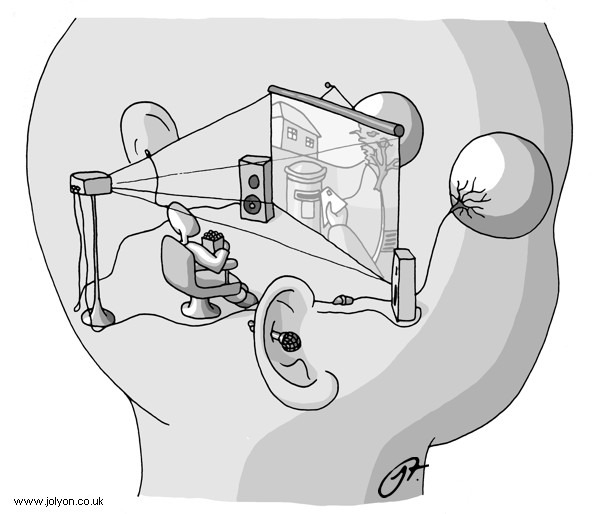
Brain constraint represents all the ways our reality is transformed and skewed before we actually experience it.
Brain constraint prevents us from directly knowing how our reality is different from objective reality, or from the reality of other people.
Here are the 4 major categories:
1) Our reality is an imperfect replica – a prediction or construction of our brain
References
- Your Brain Hallucinates Reality
Anil Seth, Neuroscientist - Your Brain Is a Prediction Engine
Christof Koch, Neuroscientist - Your Brain Is Biased by Default
David Eagleman, Neuroscientist - The Extended and Predicted Mind
Andy Clark, Cognitive Philosopher - What Your Brain Does When You’re Doing Nothing
Marcus Raichle, Neurologist
2) Our reality is warped non-consciously
References
- Book Summary: Self-Illusion
Bruce Hood, Psychologist - Your Brain: Who’s in Control?
PBS: Various Scientists - Types of Cognitive Distortions
UP Medical Center
3) Our thoughts are made-up, often inaccurately
References
- Your Storytelling Brain
Michael Gazzaniga, Neuroscientist - No Self No Problem
Chris Niebauer, Neuropsychologist - The Left Brain Bullshitter
Scientific American
4) Our behavior is manipulated, often imperceptibly
References
- Operant Conditioning
Steven Kushner, Psychologist
*Philosophers and scientists debate what “objective reality” really is. Leaving this aside, it is fair to say “something” exists prior to our brain and senses. Each of our realities is our brain’s representation of this “something”. Each of our realities is unique and inconsistent, in this sense.
Takeaway
We live in a metaphorical personal bubble – which is limited, often incoherent, and shaped outside our awareness (see “key aspects” above) – yet from a first person experience we feel our reality is flawless. This bubble constitutes all perception – feelings, thoughts, identity, habits, biases, beliefs, desires, and behaviors. We potentially spend years, or lifetimes, unquestionably loyal to this bubble, oblivious to its flaws. This contributes to misunderstanding and suffering.
What to Do?
While we can’t eliminate brain constraint – it is possible to sense its confines and push beyond them.
Self-Investigation
- Who are we? By rigorously exploring the many layers of this question, including the architecture of the mind and brain, and the emotions, instincts, and sensations that dominate human experience, we come to understand ourselves. This empowers us to put our subjective reality into perspective. See here.
Resources & Sponsors
Self-Investigation.org is a non-profit website that combats brain constraint through a question: “Who are we?”. Our library is devoted to answering this from as many angles as possible. Although no answer is complete, by exploring several dimensions of our perception and history, we better understand our limits, and can work against them.
This article is a non-profit community effort. All feedback – suggestions, questions, comments of support – will be considered and incorporated into future versions of this article. To participate, contact us.
Additional References
“Each of us believes himself to live directly within the world that surrounds him, to sense its objects and events precisely, and to live in real and current time. I assert that these are perceptual illusions … Each of us lives within the universe – the prison of his own brain.”
Vernon B. Mountcastle, 1975
“The self, the place where we live, is a place of illusion. Goodness is connected with the attempt to see the unself… to pierce the veil of selfish consciousness and join the world as it really is.”
Iris Murdoch
“All you’ve got to go on is streams of electrical impulses which are only indirectly related to things in the world. Perception has to be a process of informed guesswork in which the brain combines these sensory signals with its prior expectations or beliefs about the way the world is to form its best guess of what caused those signals.”
Anil Seth
“The world in our heads is not a precise replica of reality; our expectations about the frequency of events are distorted by the prevalence and emotional intensity of the messages to which we are exposed.”
Daniel Kahneman
“We are never simply seeing what’s ‘really there,’ stripped bare of our own anticipations or insulated from our own past experiences. Instead, all human experience is part phantom — the product of deep-set predictions.”
Andy Clark
“We are touchingly prone to mistaking our models of reality for reality itself, mistaking the strength of our certainty for strength of evidence, thus moving through a dream of our own making that we call life.”
Maria Popova
“We do not see reality as it is. We are shaped with tricks, and hacks, that keep us alive. The theory of evolution presents us with the ultimate dare: Dare to recognize that perception is not about seeing truth; it’s about having kids.”
Donald Hoffman
